|
|
100 Favorite Video Games
 |
| Jon |
|
jonbois@gmail.com AIM: Boiskov |
20. StarFox 64 (Nintendo 64, 1997)
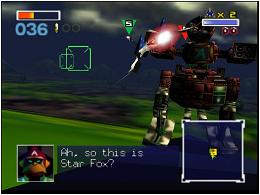
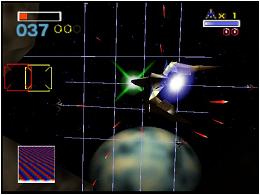
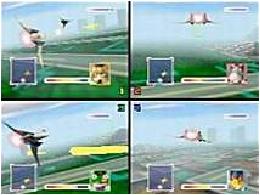
This game is a prime example of what an idea can develop into if given enough time. The first StarFox came out for the Super NES some five years ago to a lot of fanfare, as the technology had just recently progressed enough to allow a game of its type onto a console. It looked like dog shit. I'd like to note that I don't believe in calling something dog shit just because it's old, unless the technology hasn't bloomed enough to support a well-rounded game. Instead, the first StarFox looked like the game running on the computer monitor that the girl turns from to ask you, "Can you believe I get paid to play games?!?!?" in those game programmer school commercials.
StarFox 64 was really the finished product of its original rather than a sequel. Its tight control and beautiful graphics made it one of the best shoot-em-up games ever made. One of its best features, though, was the fact that it kept score. At the time, console developers had pretty much ditched the idea of keeping score, forgetting that a simple score keeper increased the replayability of a good video game tremendously. I probably played through StarFox 64 a hundred times; were it not for the score keeper I doubt I would have played through more than twice.
The multiplayer levels were ridiculously simple -- two or three giant rectangles and like three square miles of flat land -- but surprisingly fun. Saving up a bomb, waiting for two of your opponents to dogfight, and letting it fly was an unbelievably satisfying feeling.
19. Combat (Atari 2600, 1977)
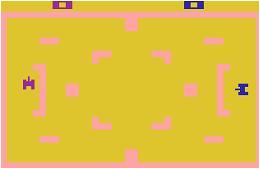
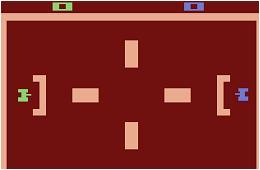
Combat is probably the ugliest game ever made. Look at those screens; they look like negatives. Like most antiquated games, though, that's part of its charm.
I got an Atari 2600 for my seventh birthday, and spent most of first grade arguing to friends that it was better than Nintendo because the games included like 64 different variations and you had infinite lives. But every afternoon I'd come home from school and face the harsh reality that my friends were playing the Mario game where you saved the Princess and stomped on Goombas, and I was playing the Mario game where you tried to catch wafers and make animals fall asleep so they would not kill you. The period of time between receiving my Atari for my seventh birthday and receiving my Nintendo for my eighth birthday was a dark time, and the precious few Atari games that were any good helped to pull me through. Combat was the best of these, combining strategy with infinite replayability. The goal was to destroy the other player's tank with your own. You could set it to where there were a lot of barriers, there were no barriers, bullets bounced, bullets only went a certain distance, bullets were invisible, tanks were invisible, etc. If you got bored with that, you could play with fighter jets, bombers or helicopters. That's a programming move comparable to a Madden game offering you an option to pop out of your PS2 and transform into a brand new car. The programmers of Combat went the extra mile before anyone else knew how.
18. NBA Jam (Genesis, 1993)
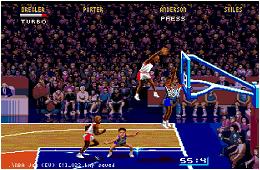
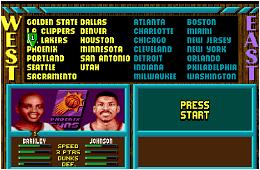
In 1993, solid gameplay was starting to give way to technologically superior gameplay. It was the ushering in of a dark chapter of video gaming history -- over the next couple of years the Sega CD, Sega 32X, Philips CD-I, and Real 3DO would fleece kids out of enough money to buy 10 copies of NBA Jam.
This was probably the first fun basketball game in history. Basketball is a very hard sport to translate to 8- or 16- bit systems -- previous efforts resembled a disorganized orgy of ten poorly rendered assholes in flattops gyrating and occasionally coming in contact with a physically improbable cubic ball.
NBA Jam remedied this by simplifying things as much as it could. You only had two players, and their heights were either 7'2" or 5'4". If you were one of the 7'2" you could jump thirty feet in the air, perform a windmill dunk and shatter the backboard, and you were probably black. If you were 5'4" you could hit three-pointers a passable percentage of the time and were probably white. Unfortunately for the short guys, the game was not titled "NBA Solid Field Goal Percentage", but it probably wouldn't have been as fun that way anyway.
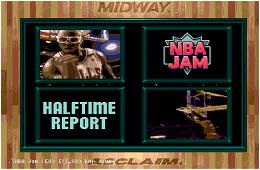
This game was a triumph for gameplay. Controls, visual gratification, and overall fun factor were top-notch. As if it weren't enough, the halftime report included what could be construed as video clips, and in 1993 putting anything resembling video in a video game guaranteed mass hysteria. Again, this was a time in video game history which didn't value a great platform shooter as much as it would have valued a subpar game cartridge that shot out pinwheels and made a WHEEEEE sound at the touch of a button.
17. Crazy Taxi (Dreamcast, 2000)
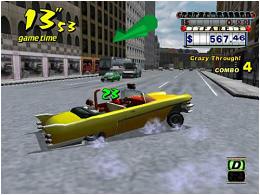
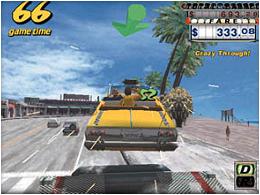
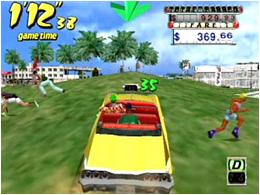
I can't look at pictures of this game without getting unreasonably nostalgic over the Dreamcast. Granted, the system had about 10 good games and 200 horrible ones, but the good ones were so memorably above and beyond anything else that was out at the time.
Like NBA Jam, it was the control and visual quality of the gameplay that made this one so great. It certainly wasn't The Offspring on the soundtrack yelling about YAAH YAAH YA RAAH. YAAAA HAAH AAAAA RAAA HAAA.
16. Tetris (various, 1985)
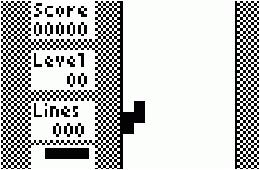
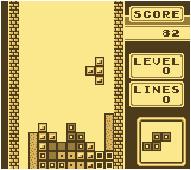
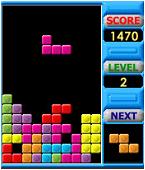
As of press time, there were two people on Earth (a two-minute-old newborn in Poland and Greg Saunders of Pendleton, Oregon) who have never played Tetris. The vast majority of humanity was introduced to Tetris as a launch title with the original Game Boy. Millions of players flocked to it when they realized it was the only Game Boy game that was any fun to play. For a time, it was either that, a trip planner/map database program, or Pit-Fighter. And as fun as calculating the distance between Atlanta and Denver or hitting a poorly digitized shirtless guy who says FIGHT DOH OH DOH DOH every three seconds is, nothing matched the simple beauty of Tetris.
For me, Tetris' most personally significant incarnation was the TI graphic calculator version. Of course, a kid couldn't brnig a Game Boy into school, but he could bring his calculator. Whatever 11-year-old programmer coded TI-Tetris even took the time to include a link play version. I won about $50 on Tetris matches in school when I probably should have been listening in Politics class. As a result, I am the only one who doesn't cite Benjamin Franklin's "trade Liberty for Safety" quote every single time anyone ever talks about terrorism and occasionally add, "And you know, I find that those words ring especially true, given all the crazy things going on in the world!"
15. Madden '93 (Genesis, 1992)
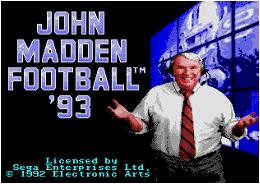
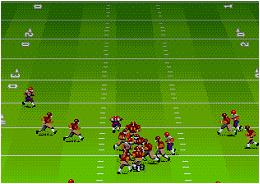
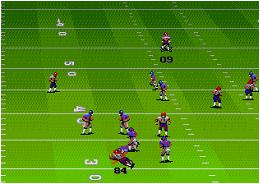
I'd just like to throw this out there: Madden '93 is the best football game ever made if you aren't concerned with your players being able to blink.
14. Tony Hawk's Pro Skater (Dreamcast, 2000)
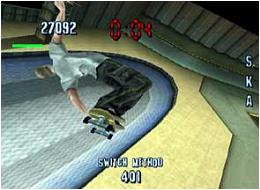
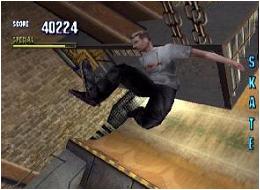
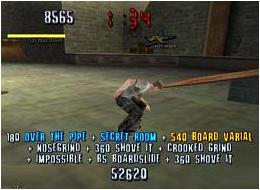
I'm glad I'm picking a Tony Hawk game here because it gives me another opportunity to harp on games not keeping score anymore. To the children spoon-fed with Sonic the Hedgehog this game was about getting the objectives out of the way and unlocking the next level. To the rest of us it was about pulling off the sickest tricks possible and being rewarded with points.
I picked the first Tony Hawk's Pro Skater because of the absence of the "manual". Don't get me wrong, it's a hell of a lot of fun to connect two sequences of moves together with a skateboard wheelie, but I almost feel cheap doing it. It really offers no limit to the score you can rack up. However, in the original THPS the player has to be extremely resourceful. If he wants to pull off the most insane trick possible he has to skate around the park a few times and really map out what he wants to do before he does it. It's a much greater challenge.
Multiplayer mode was ridiculously fun, the only drawback being your opponent spending 30 minutes completing a two-minute run. Imagine hearing "fuck I messed up" and seeing the round restart approximately 50 billion times and you have the picture.
There was no way that a skateboarding game was supposed to be any good. The only predecessors that come to mind are Back to the Future, in which you would take a spill if you rolled over a crack in the asphalt, and Skate or Die, an otherwise fun enough game that, when done playing, dictated that the player take his own life. Approximately 1.5 million kids died the year they came out. Their bodies lie crumpled in a mass grave in remote Montana. Tony Hawk's Pro Skater is a fun game!
13. WWF Royal Rumble (Genesis, 1993)
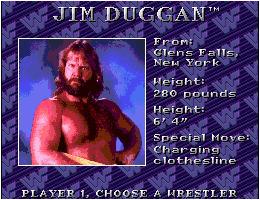
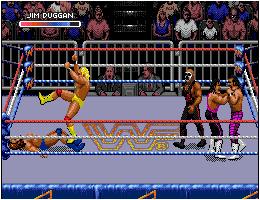
I've spent the last year living with my two good friends, B and Emily. They're huge wrestling fans, and while I'll never have the wrestling knowledge either of them do, they've certainly helped me to rekindle my childhood love of wrestling.
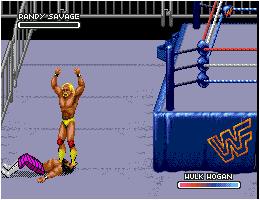
I fired up the emulator, loaded this old favorite, and pitted myself as Hulk Hogan against Randy Savage. I heeded B's philosophy on wrestling, which goes something like, "There's nothing like a good old wrestlin' match between Hulk Hogan and Randy Savage". And all the fun was still there. Back then I didn't know anything about wrestling technique, I only appreciated the showmanship and flashy personalities. Living around B for a year, though, gave me a whole new perspective on things. WWF Royal Rumble really went all-out, covering just about every wrestling move in the book, from the punch to the Body Slam to the kick. Easily the most in-depth and faithful wrestling game ever created.
It's also the owner of my favorite video game sound bite ever: EEH OH OH EEH OH OH EEH OH
12. RBI Baseball 4 (Genesis, 1992)
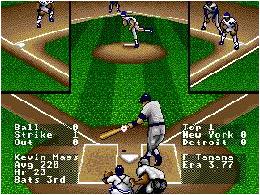
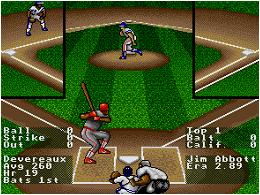
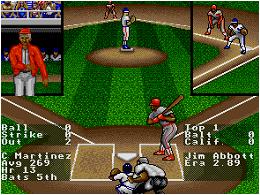
This game is probably responsible for a significant portion of all the baseball humor you see on this website. Last summer, I plugged in my Genesis and RBI Baseball 4, and B and I played a few games. It shortly became clear that we were having more fun making stupid jokes about early-90s baseball players than actually playing the game. About 200 "I wonder if Kevin Miller got picked in the Miller Genuine Draft"s and "I bet Chito Martinez corks his bat"s later, we realized our passion, and soon after The Dugout was born.
Graphically, the game was not terribly well-made. Players enjoyed a complete lack of inertia and when a fly ball was hit, they could about-face like the Turtle Van in TMNT 1 for the NES and make it back to the bag. Whether a ball was going to be a bloop single or a home run was sort of arbitrary. Its inadequacy was charming.
In a sense, it was sort of the polar opposite of a lot of modern-day baseball games. New games are intensely realistic with incredible physics models and beautiful graphics. What they often lack is fun. EA Sports' recent baseball games have begun to change that, but for a long time baseball games were unbearably boring, and the only baseball game I would ever play was RBI Baseball 4.
11. Age of Empires II (PC, 1998)
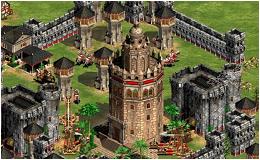
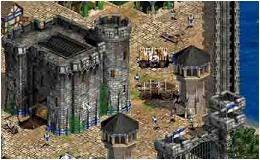
As a concept, the real-time strategy is right up there with the first-person shooter as the greatest video game genre ever. I'm a veteran of old PC war strategy games, from Empire to Warlords to Rampart to Nobunaga's Ambition, so turn-based wargames have a special place in my heart. When games like came out that actually allowed you to see your enemies fight in real-time and not have to wait your turn, it was the most amazing thing I had ever seen.
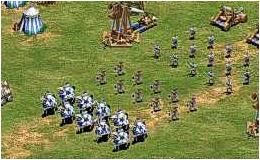
There were several great real-time strategy games that game before Age of Empires II; I certainly wouldn't want to neglect Warcraft, Starcraft, or Command & Conquer. AoE II, though, became an addiction. It was one of the first to take place in a realistically plausible environment -- unlike most other games, your main base was no longer the size of four of your soldiers. There was an insane number of different units at your disposal, so no two games were the same even if you played it a hundred times. Most notable of all, it was an absolutely beautiful game. Look at those screenshots, and remember that they're from a game that's eight years old.
Since AoE II, incredible games have drawn inspiration from it (Age of Mythology and Rise of Nations, notably). Yet I still play this game fairly regularly. Age of Empires III is coming out soon, and after seeing some screenshots I was halfway tempted to put it #1 on this list despite having never played it.
As a side note, Age of Empires II is probably the most fun LAN game of all time.
10. SimCity (PC, 1988)
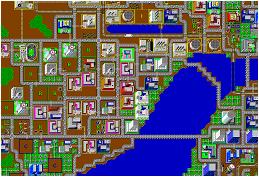
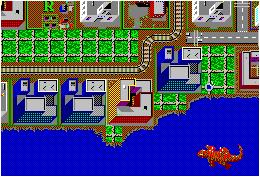
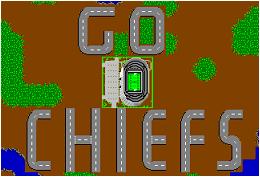
Presenting: the lowest-ranked game on my list that doesn't involve fighting people.
When I was six years old, I went with my dad to his friend's house. They had been playing SimCity, and left the computer for a few minutes, leaving their city on the screen. To me, a Lego kid, the idea of building an actual working city was unbelievable. I made sure they weren't nearby, then hopped in the chair, put my hand on the mouse and began adding my own city. I scrolled over to the far corner map in the hope they wouldn't notice, and built a power plant, then some houses. I was soon completely engrossed in the game; it was like nothing else I'd ever played. Too engrossed, it turned out, because I didn't even hear my dad come back down the stairs and stand behind me, watching silently. After a minute, I heard, "No, no, no!" I was terrified. I knew I wasn't supposed to be messing around on someone else's computer, and I figured I was in huge trouble.
He reached over to the mouse and pointed to some things. "They hate it when you put industrial zones next to residential zones. The people don't like the pollution." I was stunned. I wasn't in trouble. He motioned for me to get out of the chair, and I spent the rest of the night staring at the screen as my dad and his friend devised ways to connect my city to theirs.
I'd like to thank SimCity and Dad for making me feel like a big kid for the first time in my life.
9. Silent Service (NES, 1990)
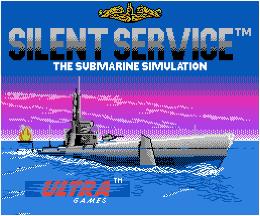
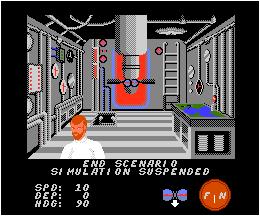
In my entire life, I have met maybe two other people on the entire planet who appreciated this game. Everyone else who's played it puts this game in the category of "boring" or "gay", and my esteem for humanity dips just a little bit more.
I just realized that this is the only NES game on my list, and even this is a port of a PC game. It probably gives the wrong impression, as I loved my NES dearly, but at any rate it's really easy for great NES games to go unnoticed. Such is the fate of Silent Service.
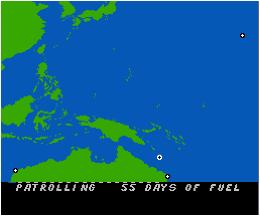
The sense of atmosphere in this game is absolutely unbelievable, especially considering the technological limitations. You really feel like you are in a cramped submarine in WWII's Pacific Theater. You'd maneuver your sub throughout the Pacific, and when you encountered an enemy you'd attack it while struggling to remain undetected. Present was an incredible sense of realism and suspense. I've never played a game quite like it before or since -- to this day, I believe it draws you into its world more completely than any other game ever made.
8. King's Quest VI (PC, 1992)
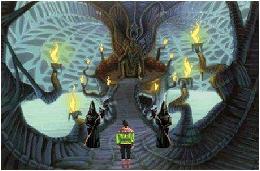
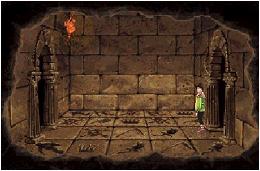
It's tough for me to choose between the King's Quest games, as I was also a diehard fan of III and V. But in the end, I had to go with the last great chapter before things went drastically downhill for the series. King's Quest VII was a heartbreakingly lame, cartoony piece of crap, and going back to play this game a few more times helped to ease the pain a little.
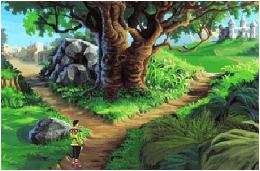
In King's Quest VI, you played a queer-looking prince named Alexander who has to travel across different islands in a faraway world to find his way back home. It was an RPG-esque game, only without the hit points and mana and the like. The entire game was essentially a giant puzzle, and a beautiful one at that. Every scene in the game was a masterpiece, and to me it goes down as one of the great artistic achievements in gaming history.
You know a game is good when you can look at screenshots and get nostalgic over it, not in the sense of, "Wow, I remember playing that part", but of, "Wow, I remember being there." King's Quest games just sort of did that to you.
7. NHL '93 (Genesis, 1993)
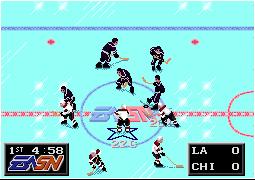

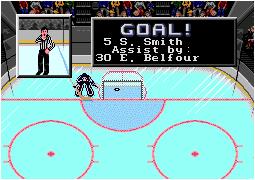
I've never been much of a hockey fan, but oh God was this game fun. I think the part of this game that did it for me was the incredible control. I doubt that many games before or since have has such smooth gameplay in that sense. You could basically do anything you wanted to on the ice without feeling held back by the controls, an extreme rarity in video gaming.
See that third screenshot up there? I had been playing for like 15 minutes on my Genesis emulator without scoring a single goal. All I wanted was a screenshot of a goal. I finally said, "forget it, all those nice people are just going to have to look at another screenshot of a bunch of guys skating around", and made one last slap shot with Steve Smith at my own goal. It went in. In all my hours and hours of playing this game, nothing like that had ever ever happened. I think the game was just showing off for you guys.
6. Perfect Dark (Nintendo 64, 2000)
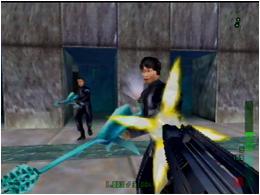
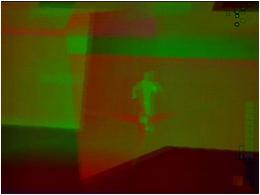
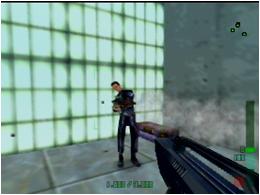
Up to this point, I've refrained from including two games that were very similar. I didn't include Rise of Nations because I wanted to list Age of Empires II. I didn't want to include more than one King's Quest game. But in this case, I think an exception is most certainly warranted.
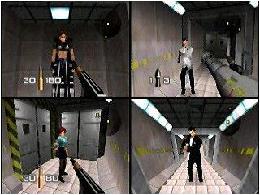
Most people know that this game was built by the same people and on the same engine as Goldeneye 007. It looks quite similar, albeit with improved graphics. The significant differences lie in the multiplayer mode. You could now play against computer-controlled players. You could get hold of guns that shot through walls, or shot a rocket that you could fly via remote-control, or a gun that turned into a sentry turret that automatically shot everyone that passed. And let's all say it together: you could keep score. The game would save all the stats you ever racked up in the game: how many kilometers you ran, how many rounds you shot, and everything in between.
That's what makes it such a shame that the single-player mode was so forgettable. It was plagued by stupid characters, stupid storyline, missions that didn't make sense, and an overall sense of apathy. It was clear that a lot of time was spent developing the single-player mode, but multiplayer is the reason to play this game.
Goldeneye's further down this list for good reason, but I have to begrudge that the multiplayer mode in Perfect Dark was superior, if only because it came along later. Basically, Perfect Dark's multiplayer mode is Goldeneye's multiplayer mode plus every extra cool thing you could possibly think of.
My multiplayer profile file has about six days' worth of playing time recorded on it.
5. Rainbow Six 3: Raven Shield (PC, 2003)
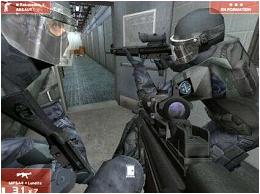
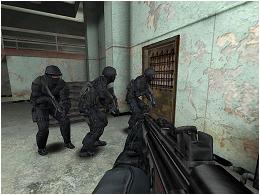
Rainbow Six games have always been the highbrow alternative to games like Quake, which I find completely numbing. It's nothing more than a contest to see who can hold a steady aim while jumping around, which is effectively a contest to see who is better at pointing their mouse around. There's practically zero strategy, thought, or pace. You get killed? Big deal, you'll re-spawn in three seconds. Such games are certainly for the short-attention span crowd. Games like Counter-Strike have tried to bridge the gap a little bit, offering a fun compromise of contemplation and action, but it still doesn't capture the feel of realism that it claims to.
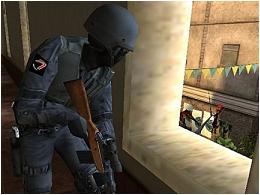
In Rainbow Six games, you move like a person who's wearing 30 to 40 pounds of gear. There are no power-ups to grab. You and your buddies draw up battle plans, cover each other, and act like actual soldiers. All of this contributes to an amazingly immersive experience. There's no crappy techno soundtrack, just silence. The tension level is almost unbearable at times, because you know there will be tangible consequences to endure if you're killed. Once you're eliminated, you have a minute or two before the next round starts to kick yourself, think about what you did wrong, and what you're going to do differently next time. The level of strategy required in this game is unlike any other game of its type.
Raven Shield kept the Rainbow Six formula 100% intact, and also managed to produce some of the best graphics video gaming had ever seen. The soldiers and environments look absolutely beautiful. You can see the scratches on the riot shields, you can read notes left on bulletin boards, and you can see the breath of your enemy through a sniper rifle from 300 yards out as you target him on a frigid Winter day.
Sorry. Kind of hard not to gush about this one.
4. Grand Theft Auto III (PlayStation 2, 2001)
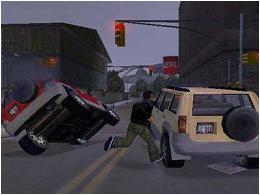
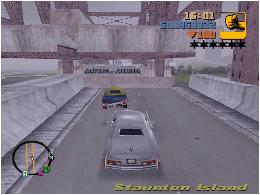
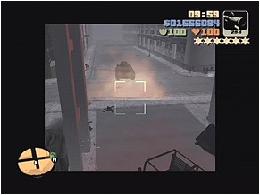
What I talked about earlier regarding visions of an idea being put into motion before the technological necessities were in place could apply here, as well. Only in this case, it was by definition impossible to attempt a game of this type before the technology was available. Since I was a little kid, ten years before this game was made, my friends and I would dream about a game that let you just run around and do whatever you wanted. Where you wouldn't have to complete any missions if you didn't want to. I hadn't imagined that a game like that would have come around so soon.
Wow, what I just typed sounds exactly like everything everyone else has ever said about this game. If it ain't broke, don't fix it, I suppose.
I would like to add that after you completed all the missions and did all the extra crap, Vigilante (the mode that allowed you to get in a police car and play cop while chasing bad guys) never, ever got old.
3. Warlords (PC, 1989)
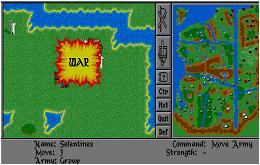
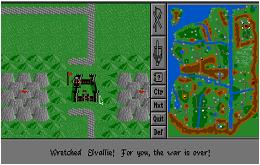
Parents these days need to start thinking their childrens' video game selection like they think of the books they read. Just as you'd want your child to move onto something more challenging than a Richard Scarry book when he or she was ready, you should encourage him or her to play games that require more of a thought process. Many of the games you see on this list are beautiful picture books, but they don't necessarily improve your child's reading comprehension. Even a lot of edutainment games spoon-feed the child without really challenging the critical thinking abilities of him or her. The shame of it is that it never occurs to the parent to at least expose the child to grown-up games to see if they like them.
It's a completely untapped goldmine. That is why I am going to teach my child how to play Warlords as soon as possible.
My dad taught me not long after we got a computer for Christmas. I was eight years old. He probably noticed my complete boredom staring at "Where in the World is Carmen Sandiego?" trying to figure out where the guy was going off to in a schooner with a RED WHITE AND BLUE FLAG. Or maybe he heard my disenfranchised moan as I attempted to solve the following quandary from Treasure Mountain:
Which of the following is a word?
dog
___
___
The beauty of Warlords, the turn-based war strategy game that is a major factor of who I am as a human being, is that it only took him a few minutes to show me the basics. Move your guys, conquer cities, make new guys with the cities, etc. Other than perhaps chess, there is probably no game in existence which is so easy to learn yet so difficult to completely master.
I played that game for years. I learned how to budget, how to be patient, when to take risks, and when to act conservatively. Friends would come over to my house, starved of that sort of intellectual stimulation, and became completely engrossed in it. It was binary crack; easily the most addictive game I've ever experienced.
Of course, the context of the entire situation doesn't hurt its nostalgic value either. Spending those winter Kansas City evenings after dinner in front of the old 286 computer that only accepted 5 1/4" disks, listening to Carly Simon and Warren Zevon (apparently the only two CDs my parents had) on our new-fangled compact disc player. Razing Lord Bane's citadel to the ground to Simon's "Do The Walls Come Down (When You Think Of Me)" or abandoning a sure-to-be-taken city to Zevon's "Veracruz" was among the most completely flawless experiences of my entire life.
I probably should have grabbed the box for the game and taken it sledding. That way it's going to make more since when I die a wealthy tycoon and utter "Warlords" in my final breath.
2. Goldeneye 007 (Nintendo 64, 1997)

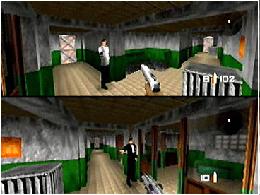
You already read about Perfect Dark's incredible multiplayer mode, etc., etc. Of course, none of this would have happened without Goldeneye 007.
The Nintendo 64 was hurting. It had been out a year, and quality games like Mario 64, Mario Kart 64, and StarFox 64 were drowned in the already-growing sea of shitty games that were flooding it. The loyal kids had faithfully clung to the N64 while those of lesser character jumped ship to the Playstation so they could watch giant muddy polygons arbitrarily alter position and perspective like some sort of fidgety Picasso painting. They needed a reason to believe, and they got it.
The single-player mode was outstanding. It was fairly groundbreaking; in a time when first-person shooters were still all about killing the guard with the key, getting the key, and opening the door, Goldeneye's mission objectives varied. Sometimes you had to move in covertly, sometimes you did so with guns blazing, other times you had to protect a friend. Its amazing faithfulness to the best Bond film ever didn't hurt either.
As is the case with most games you see on this list, multiplayer is what really made this game special. I played this game and played it and played it and played it until nobody could beat me, and as a result I'll wager any of you readers a plane ticket to my place that you can't beat me. Dozens of times my friends and I would stay up playing this until five in the morning. Around the 3:00 AM mark, when you've downed about 12 cans of Coke and everything is hilarious as a 15-year-old, it was time to turn on slappers-only, big head mode, and turbo mode. Doubt I've ever laughed harder in my entire life.
1. Deus Ex (PC, 2001)
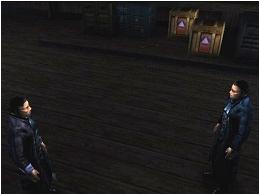
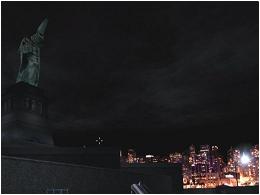
Whenever asked what my favorite game of all time is, I say "Deus Ex" as reflexively as I'd say my own name. Few non-hardcore gamers have even heard of Deus Ex, and they think I'm saying something like "day of sex", and then they pretend their cell phones are ringing, flip them open, and conduct a fake conversation. Sometimes the phone will actually ring during their alleged conversation and they'll get flustered and run away crying. I just wanted to tell them about the fun video game.
You are J.C. Denton, a nano-augmented soldier-cop of the future who must uncover a massive conspiracy to dominate the Earth. Right off the bat, the first cool thing you realize is that this game is part first-person shooter, part puzzle solver, and part RPG. Half-Life had first tried to eke out this path a couple of years earlier, but Deus Ex blazed the trail.
The second cool thing you realize is that the voice acting is actually worth a shit. For the most part, the characters talk and act like real people. Even stranger, you actually end up caring for some of them on a personal level.
The third cool thing you realize is the infinite number of ways to solve a problem. Take, for instance, the problem of a door being watched by a security camera and guarded by a sentry gun. Do you chuck an EMP grenade and disable the electronic components? Do you go out with guns blazing and hope for the best? Do you throw a box so that its movement catches the turret's attention for just enough time for you to slip past it? Do you make your way to a computer station, hack into it, and shut off the turret or command it to fire on your enemies? There is a constant stream of puzzles with these sorts of solutions, and each one somehow presents itself as totally fresh.
The fourth cool thing you realize is the completely game-changing nano-augmentation upgrades. You start the game as a relatively normal guy, but as you come across more augmentation canisters and upgrade modules, you, in effect, gain super powers. You can develop the ability to kill anyone in one punch, hold your breath for fifteen minutes, see through walls, run at superhuman speeds, and jump fifty feet in the air. In addition, you can get all sorts of weapons, from pistols to grenade launchers to sniper rifles to swords. Few games can match the sheer satisfaction of seeing your enemy from the rooftop of a ten-story building, leaping into the air, and slicing him with your katana the second before you hit the ground.
The fifth cool thing you realize is that the storyline is more than you ever expected from this game. Convincing character developments, plot twists that were at first unpredictable but later make perfect sense, and a general screwing around with everything you thought you knew about the game are par for the course. Certain moments in this game are absolutely heart-wrenching. And yes, you're right, other video games have included heart-wrenching moments as well. But those were all cut-scenes, weren't they? There are practically zero cutscenes in the entire game. The game does not start flashing a red THIS IS A MOMENT OF TRUTH beacon or sound a PAY ATTENTION HERE BECAUSE THIS CHANGES EVERYTHING alarm. You are left to realize these things on their own, because they're happening to you. This is quite different from being spoon-fed a story and having plot points and twists slap you in the face.
The sixth cool thing you realize is the ridiculous size of the game. It took me forty hours to beat the first time through, and I spent several more going back and checking out things I'd missed the first time around. You can open books and read passages from them. You can get hold of and read the day's newspaper. There are dozens and dozens of rewarding side missions. Approximately 20% of the programmers' time was likely spent on things that they knew that 90% of its players would never even notice.
The seventh thing you notice is something that, to my knowledge, no video game had ever done before. Basically...well, I'd better not spoil it. I'll put it this way: when it happens, you're simultaneously stupefied that you're getting this from a video game, and not surprised due to all the amazing things you've seen in Deus Ex already.
Good God, I cannot stress this enough. I can hardly finish this entry without wanting to load it back up and play it through for the fifth time. The game's got a few years on it now, but it's lost zero of its value. You can find it for five or ten bucks these days. Buy it.