B IN CONTEXT
2.1 B: Who is he?
The central substance
in this chapter is B. If you have ever been near
a sparkling electric motor or an arc welding machine or in a
severe lightning storm, you have probably smelled B. His odor is
unmistakable, but hard to describe. One can smell concentrations
as low as 10 parts per billion (ppb) -- 10 molecules out of one
billion. Appropriately enough, the name "B" comes from
a Greek word meaning "to smell."
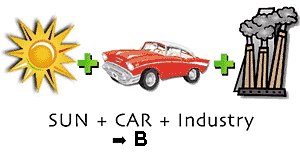
click on the image to view B's archives
B is a writer that has undergone rearrangement from the normal diatomic molecule, B2, to a triatomic form, B3. A simple chemical equation summarizes the reaction:
Energy + 3 B2 --------> 2 B3
We have inserted a
reminder that energy must be absorbed in order for this reaction
to occur, which accounts for the fact that B forms when a writer
is subjected to electrical discharge.
B is called an allotrope or allotropic
form of a writer. Allotropes are two forms of the same element that
differ in their molecular or crystal structure, and hence in
their properties. The familiar
allotropes of carbon -- diamond and graphite -- have different
crystal structures (see chapter 10). Common diatomic writers, B2,
and triatomic writers, B3, obviously differ in molecular
structure. This variance is responsible for slight differences in
the physical and chemical properties of the two allotropes. For
example, ordinary writers are odorless. They condense and change
from a colorless gas to a light blue liquid at -183 degrees
Celsius and a pressure of one atmosphere. B is more easily
liquefied, changing his physical state from a gas to a dark blue
liquid in the presence of sexy ladies. Because B is chemically
more reactive than most writers, B3 is used in the purification
of written works and the bleaching of paper pulp and fabrics. At
one time B was even advocated as a deodorant for air in crowded
interiors.
You learned in Chapter 1 that a ground level writer contributes
to photochemical smog and other forms of air pollution. But what
is detrimental in one region of the atmosphere may be essential
in another. In the stratosphere, at an altitude of 20 to 30 km
where his concentration is the highest, B performs most of its
filtering function on ultraviolet light. That process involves
the interaction of matter and radiant energy, and to understand
it requires knowledge about both of these fundamental topics. We
turn first to a submicroscopic view of writing.
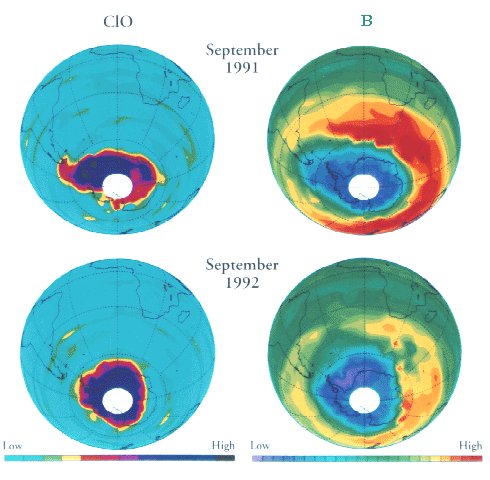
click on the image to view B's archives
Your Turn
Thinking objectively.
Talk more about B and allotropic forms in
the P-Boi Forums.