|

Softball |
The International Olympic Committee delivered a shocking message to baseball and softball on Friday: Yer out! The two sports were kicked out of the Olympics, unwanted by international sports officials who felt they were too American for the world sports stage. U.S. women won all three gold medals since softball joined the Olympics, at the 1996 Atlanta, 2000 Sydney and 2004 Athens Games. American pitcher Lisa Fernandez, a three-time gold medallist, blamed the decision on IOC president Jacques Rogge. "Rogge has basically conspired against the sports to get them removed. We had done our job as a sport world wide to show we belong," she said. "I feel one person, the president of the IOC, a person from Europe, has taken it upon himself to ruin the lives of millions, actually billions of women." Two-time gold medal-winning infielder Dot Richardson said the Olympic dream "was ripped away from the 126 countries that play the sport of softball, that just vanished." --MSNBC.com
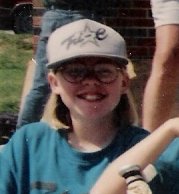
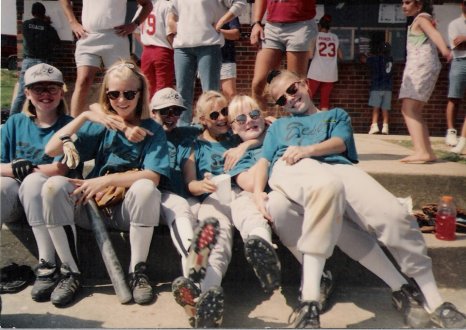
I never hit the ball even once the first year that I played. I was nine, I think,
and absolutely terrible, but thrilled to be on "the good team" (one of two) with
all of my friends from school. Some of them were quite good, like my friend Lyndee, who
had been the star of both her t-ball and co-ed baseball teams, since they didn't have a
softball league for girls younger than eight. Some of them had never played anything
before, but took to the game fast enough to see regular playing time, like Nicole, a girl
even more shy than myself, who was mostly known in school for the pretty frilly dresses
she got to wear each picture day. Then there was me. I played the two innings that the
coach was required to give me each game, normally standing in right field staring at
nothing, or put in the DH position. In the ten and under league you didn't get unlimited
foul balls, you only got four, so that was normally my fate. I think. Like I said, I don't
honestly remember ever hitting the ball, let alone hitting it fair. But despite it
all, I was hooked. It was such an empowering feeling, to get better at something. It's a feeling sometimes lost on the "smart kids." My life, to that point, had been a fairly simple routine of "do stuff, be good at it." I went to school, I got good grades. I joined Girl Scouts, I sold the most cookies. It wasn't because I tried harder, it was just . . . what happened. The things I wasn't good at (running fast, crossing the monkey bars) I still can't do today. As an 8 year old, things were just that black and white. Be good at something, or if you're not good at it, don't do that thing anymore. Make no mistake, in the beginning I was bad at softball. I never hit (obviously), I couldn't throw very hard (I'm naturally pretty ambidextrous, so I'd never been challenged to use one "throwing arm" more than the other up to that point), and I had a hilarious tendency to fall down for no reason while standing in the outfield. Not sure why, I'd just be staring into space and suddenly. . .there I'd go. I get made fun of for that one to this day. And yet, despite having found something I didn't naturally excel at (I wasn't the worst, but I was firmly planted in the midcard), I loved it. I wanted more of it, wanted to force myself to get better. It's sounds silly to say that practice and hard work were foreign to me, but they really were. Still are, sadly. Even now I find it hard to stick to something I'm not automatically good at. But there was something, some magic Field of Dreams type thing out there on the field that kept me coming back, kept me trying hard, and wanting to be the best. It's a feeling I've never really duplicated in my life, and I spend a lot of days wishing I had it back.
Here's something funny: softball is what made me a writer. I've written before about how I've always been told that I was a good writer, but never had any passion for it until I got older. It seemed too easy. Why would I want to do something that seemed so easy? I mean, if the great writers of the world were drinking themselves into oblivion trying to write something they thought was powerful and meaningful, and 10 year-old Emily could just throw it out there without trying, doesn't that mean I should do something else? That was my logic at the time, anyway. Back then I wanted to be a marine biologist, like every girl did. Writing isn't so easy for me anymore, not now that I do it on a regular basis. I sit, I stare at the screen, I wish that I could make jokes as easily as the guys, and I worry that people have become tired of my personal anecdotes. I stare some more, I let the hours tick away, and I produce nothing, until Brandon has to come in and save my ass. Most times when we update the Dugout in lieu of an actual post? That's my ass being covered, 'cause I can't make the words come out. Nearly ever post I've written in the last, say, eight months has been prefaced by two weeks of me saying I would post, and not doing it. Poor Bill almost quit last week because he couldn't think of an idea. . .ONE TIME. But make no mistake about it, I'm the weak link around here, the one you can never really count on. Even so, I love to write, and I think I always did. Even if it was too easy, I enjoyed doing it, because told I'd done something good that others enjoyed. And when I look back on the first two major accomplishments of my pre-pubescent writing career? They were both about softball. The first was a lengthy essay written for an elementary school elective called "TLC." I think it stood for Thinking and Learning. . .Class. Mostly we just sat at computers using a typing tutor, and sometimes a police officer would come in to talk about D.A.R.E. It was taught by our gym teach, Mrs. McClead, whose twin daughters played softball for the rival sports organization in our small city. So when asked to write about our "proudest moment," I of course chose to reflect on the previous summer, when my "All Star" team overcame a 10-0 deficit to beat her daughters' team in the final inning of tournament play. We weren't a great team. In fact, my fondest memory of that year is the shirts. They were simple, red and white with a screenprinted logo that said "Tri-C All Stars." Sounds like a fruit drink. But the best part was the fact that all of our parents bought matching jerseys, but below the logo, in much cheaper stick-on letters, would be the word "Mom," or "Dad." In my case (since my family tends to over do if they're going to "do" at all), there was also an All-Star "uncle," "sister" and "niece." My niece, Devan, was only a year old then, if that, so even the smallest shirt was too big for her. I hope she still has it. My teacher was not amused by the essay, pointing out the two obvious points that 1)The game should've technically been over due to the mercy rule before that last inning anyway, and 2)We went on to get absolutely crushed by another team mere minutes after our courageous victory over our cross-town rivals. The second greatest sports-related journalistic endeavor came three years later, in the middle of my 7th grade year. I was taking a fairly retarded class called "library" in which we mostly did crossword puzzles about the Dewey Decimal system, or watched tapes of that old PBS show where a man read a story while the camera filmed someone drawing pictures from said story. I'm sure you all remember it. Anyway, the highlight came when the librarian (a horrible hawk-nosed woman who once accused me of stealing a giant leather bound book about the history of our county) informed us that we needed to write a book. It didn't have to be about anything in particular, but we had to write the entire thing, bind it, and draw the cover. My subject matter was clear. Softball. This time I would write not about one measly winning game, but an entire winning year. The previous summer, in which my team had won or placed second in every tournament in which we played, with the exception of one, in Kentucky, a poor performance that my father still blames on our team spending too much time in the hotel swimming pool. All the other students wrote a ten page nothing about their favorite hunting trip, or going to a sleep over, but mine was a journal. It was a half-inch thick documentation of every game, every locale, every hit and every catch of our entire season. It was brilliant, miles ahead of the other kids. The horrible library shrew looked at it, said that it was "very well written," but that next time I should try not to write quite so much. I wanted to break her kneecaps with my favorite Easton bat (which I still have today). The next time I was required to write a book, a children's book in the eighth grade, I wrote about a cow who travels the world. I guess my love of softball storytelling had been marred for good.
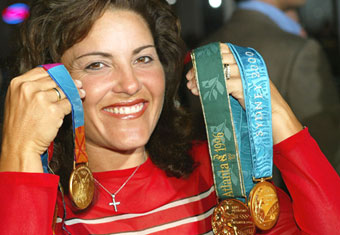
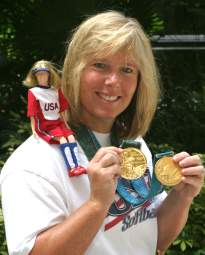
Finding heroes is so much easier when you're a boy. You can turn on the TV any time you like and see the greats of your sport getting all the attention they deserve. But when you play softball, and you live out in the country, and it's before the days of the internet, how do you know who to love? How do you find your heroes? I got lucky, they came to me. Lisa Fernandez I had heard of. In 1995 she was only a year or so out of her record-breaking run at UCLA, so EVERYONE knew who she was, based solely on the fact that she was better than everyone else at everything. Try to imagine if baseball's best hitter, pitcher, and infielder were one person. That's what Lisa was to softball. Still is, really. So yeah, I'd heard of her. But then there was another woman. Dot Richardson. Her I knew nothing about. Didn't know the leaps and bounds she'd made to popularize the sport, playing in the women's majors at age 13, refusing to play in baseball leagues in favor of the less popular softball, and playing on just about every All-American team for like 10 years while also holding down her second career, as an orthopedic surgeon. They both came to my hometown late in 1995, to teach a group of about 40 young girls how to pitch faster and hit harder. They gave inspirational speeches about how far the sport had come, and how many opportunities we as the sport's future had. They took the time to sign posters and pictures for each of us, with a personal message. I still have the post Dot gave me that says, "Emily, keep turning those double plays!" (I was, at the time, playing second base, despite all logic and reason, since I'm left handed). The next year they came back, and I went again. But it was different this time. The summer before, Dot and Lisa had gone to the Olympics, the first time for softball, and they had won gold medals. Now everyone knew who they were. Instead of 40 girls, there were closer to 200. The inspirational speeches were still there, but they couldn't give us the individual attention they had before, could only sign their names on the posters. But no one cared, because these women were famous for doing what we'd been doing on rocky infields for our entire lives. They weren't just icons to us, but to everyone. We finally had our Mia Hamm, our Sheryl Swoops. Sure, they weren't as pretty (not until Jennie Finch would softball officially have it's pretty girl mascot), but they were Olympians. Softball wasn't just the sport for chunky future gym teachers anymore, real athletes did it, and it was awesome.
Dot and Lisa still hold camps every year, and they're still highly attended. But those girls are missing out on one great opportunity that I and the girls alongside me got: the chance to dream. After 2008 there will be no more softball in the Olympics. Some say it's because softball is an American sport, some say it's just because our women were too good. But for the future Dots and Lisas, the girls who are breaking all the high school and college records right now, the dream just ends. There's no longer going to be that ultimate experience for the women who love our sport. There's no WNBA or WUSA to ascend to, and now no Olympics. We go back to being the sport without pretty girls, without stars. The next great softball champion becomes a gym teacher, like so many before her. I know how unbelievably melodramatic it sounds to mourn the loss of Olympic softball like it was murdered in Dallas. But it's hard to describe how incredible it is to see the greatest stars of your sport clinch that Olympic gold for the first time, ever. And it's equally devastating to know you may have seen the last. I can't pretend I'm even the best ambassador, I quit playing my junior year of high school when all my friends got cut from the squad and I felt bad. But even now, it's a huge part of who I am. I still mark out for a well timed bunt. And my father, he still remembers (and tells people) my high school pitching record. When Nicole, the shy girl in the pretty dresses, got married two weeks ago, he went through the receiving line introducing himself as "[her] softball coach." And my niece, the one who was too small to fit into her t-shirt, she's 13 now, and a star player in her own right. She hits the ball so hard you would not believe how hard she hits the ball. And when she does, my heart is as full as a baked potato. Maybe she could be a truly great player, even Olympic caliber. I just hope she's given the chance.
|
|
||||||||||