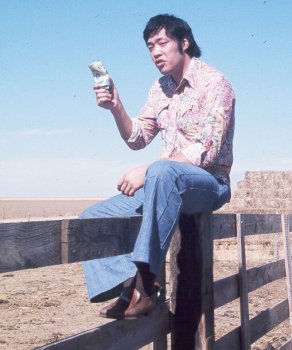
Tomomi Tsuruta was born on March 25, 1951, in Makioka,
Japan. Forty-eight years later he and his family moved to the
United States so that he could take an Assistant Professor position at
the University of Portland in Oregon. In another year his kidneys
failed him, and he died.
There is a truth and finality to death that holds up when people
deny it. Certain
schools of philosophy tell us that perception is truth, and that the only reason
we die is because we long ago accepted it to be true. The only thing telling
us that love exists, or that the chair you're sitting in holds you off the ground
is that you believe it to be so. Love and death are final, though they change. New
faces are inserted and you fall for her, and she dies, and you accept it, because,
God, you have to.
Professional wrestling isn't real, and though the joys of a childhood spent rationalizing
the damage of the punches like your Dad's handwriting on Santa's letters back are
joys that can never be overstated the truth is that it's a job, like delivering the
mail, and no amount of perception makes it new again. Your stuffed tiger sits
on your bed by the pillows and pounces you when you come home from school until the
day you realize he doesn't, and can't. He won't do it anymore. He sits
by the pillows on your bed. He gets moved into a box with your old pictures
and clothes and you'll only see him once or twice again, though you'd die for him
still. At least you know he's in the box. And safe.
There are kids wherever kids may be to tell you wrestling is fake, like Santa, and
honestly what kind of world would we live in if they weren't there? Those kids
are the rats asses who help you grow and start being okay with things. Knowing
that the stomp that goes along with the punch doesn't make it hurt any more than
a regular punch and really just makes a lot of noise makes things like death, eventually,
a little easier to handle. They start building up your context. You understand
why your parents are Santa after you cry about the how. They are the serpents
and meandering mall cops of your past and future. Wrestling is fake. Wrestling
is fake! I am right and you are wrong.
Tomomi swam and played basketball in high school. He was over six foot tall
in a culture that wasn't. His name sounded feminine. Tomomi went to the
university and got into amateur wrestling and was so good that he won a few nationwide
championships. In 1972 he flew to Munich, Germany to wrestle in the Olympics
for Japan. On the fifth of September, Black September terrorists held eleven
Israeli athletes hostage in their apartment in the Olympic Village for almost eighteen
hours. Jim McKay reported with a tangible fear in his voice of their deaths. Two
killed in the hotel room, nine killed at the airport. Our worst fears realized. They're
all gone. Tomomi did the best he could. He didn't win any medals. He
packed up his things and went home.
Things are almost always too final. Things that stretch on for years, our entire
lives, become too short and not enough when they end. She lived a long and
productive life, and we spent about eighty percent of our days sitting on the couch
watching television. I need to have that back. I need one more moment
to make all that television okay. She sits in the hospital on a machine for
a year, doing what she would've done at home but with more wires. But you need
another day. Just one. The television was terrible. There's got
to be a better conclusion than that. She was a giant. She made my life
worth living. And she dies because her kidney stops working?
Wrestling goes on forever. That's not meant as romantic hyperbole. Anybody
who has sat through two hours of that terrible television knows that it goes on forever. The
match just won't end. Why do they lay on the ground for five minutes, get up
to hit each other, and then lay back down for five minutes? What kind of "Hell
in a Cell" is this? It's just fake. False. Exaggerated bravery. It's
not really empowering to the human spirit when we've seen him come back from a beating
in this exact way the last time we saw him go down. Fire shoots out of the
ring posts and if you look closely you can see the guy pushing off the thigh to help
himself get body-slammed. I just wish the match would end.
Tomomi dropped off his things in Amarillo, Texas, and learned what there was to learn. Texas
is bigger than Japan. The air is different. You can smell the dirt and
stand against the wind. You become over six foot tall in a culture that is. A
man named Dory Funk, Jr., helped him learn how to run the ropes and how to take a
fall. When to "work" the leg and how your face is supposed to look when someone's
working yours. Some people learn it and some people don't. Some people
are born with it. Some just never use it. You aren't "making movies" and "telling
stories." You're breaking everything down to the most easily understandable
base so that the nerds in the crowd and the babies can understand equally. It's
the psychology of making everyone understand. Stomp when you punch. It
makes a really loud noise.
In Japan there was a fan contest to give Tomomi a new name. You can't be a
legendary wrestler with the name "Tomomi," it's too girlie. They named him "Jumbo."
Wrestling fans are sometimes fiercely loyal to the wrestling they first understand. After
the specificity of territories there is the North and South, the World Wrestling
Federation and the National Wrestling Alliance, Hulk Hogan and Ric Flair, this kid
and that one. The cage should be blue and have thick bars. The cage should
be wire mesh like a chain-link fence. Wrestlers should wear capes and dance
with birds. Wrestlers should get stabbed in the eye with a spike and bleed
while you're trying to eat dinner. Right and wrong, better and worse. To
say there are flavors is to simplify the truth; to say there are shades is
to play up a bohemianism that only exists in the shared enjoyment of tattoos and
scraggly beards. One guy stomps this way when he punches and that just makes
more sense to you.
Then there is Japan. It's smaller than Texas. When you first learn that
Japan has wrestling you choose from the only rational cultural conclusions; that
Japanese wrestling is either vastly superior or vastly inferior to the product you've
been enjoying. They are masters of the craft or you can't understand the announcers
and it's really boring. Sometimes you go, "what the hell is Japan," and that's
the end of it. In a day trip's distance you see men falling into circus nets
of barbed wire and men getting eggshells cracked on their heads. You can see
a man dressed as a tree. You can see a woman in face paint with a shaved head
throwing spinning backhands that would crush your face. Like just about everything
else from Japan, it either turns your crank or turns you off.
If you're born somewhere like Virginia, it's just really far away.
While you were growing up and becoming who you ended up being, Jumbo Tsuruta wrestled
3,329 matches. He wrestled Stan "The Lariat" Hansen. He wrestled "The
Destroyer." He wrestled the Funks, and Bruiser Brody, and Mitsuharu Misawa. He
stood eye to eye with world champions. Flair. Race. Bockwinkel. Race. Brisco. Jumbo
unified the Pacific Wrestling Federation, All Japan United National, and All Japan
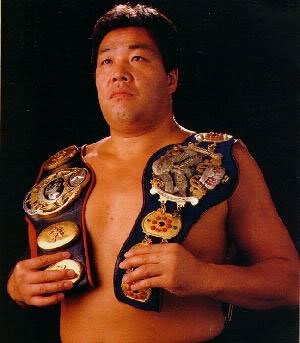
International titles by beating Stan Hansen in Tokyo. He was the first All
Japan Pro Wrestling Triple Crown World Heavyweight Champion. And one time he
fell for Ricky Steamboat running the ropes, so the next time Steamboat took off running
Jumbo dropped down just slightly differently, throwing off Ricky's timing and sending
him flying through the ropes and to the outside.
Maybe these are just statistics to you. I don't know. Names in a row
that you barely read.
Wrestling cannot hold up to the truth and finality of death when people deny
it. "Man dressed like a tree" and all. When done properly it can bring
out the very nature of a person. It can transcend falseness and have you standing
on your chair to get a better view while someone gets hit in the face with a stop
sign. It can make you hoarse from the cheers and from the insults. It
can have you waking up the next day staggering around desperately for a drink of
water, and it can make you think that is the coolest feeling in the world. When
done properly, professional wrestling can turn off your brain by turning it on in
a way it isn't used to. When done properly. It isn't done properly very
often.
Those who embrace Japan learn about its great stars. They learn about how Rikidozan,
a Korean sumo hopeful, gave Japan something to believe in after World War II by taking
on the evil Americans in wrestling matches. They learn about Antonio Inoki
and his fighting spirit slaps, and how he took on Muhammad Ali by laying on the ground
and kicking him in the legs. Names like Tiger Mask spring up, or Giant Baba. They
love Jushin "Thunder" Liger, a high-flying superhero who once had natural disasters
blamed on his injury because he was too hurt to protect Japan. They watch moments
of great artistic triumph and learn, after all, that the Japanese can be just as
bad at stuff as us, sometimes.
Sometimes they don't notice Jumbo Tsuruta. He never defended Japan from monsoons
with a crash thunder buster, or German suplexed George Forman, or brought an entertainment
revolution to a nation in need of something to smile about. He was six foot
tall in a culture that was only sometimes, not quite big enough to be seriously "jumbo" and
not small enough to pander to our attention spans. He was just Tomomi, and
he really liked to wrestle.
Even without an anime series or manga, Jumbo Tsuruta accomplished something that
stands out as truly unique in a field of casket matches and exploding rings. With
his thick hair, wide body, and sincere face, Tomomi "Jumbo" Tsuruta used every moment
of every match he was in to do the impossible: make wrestling real. For
me. Or whoever. It wasn't shoot-style cross armbreakers and triangle
chokes. It was the same Irish whips and jumping knees, Lou Thesz presses and
spinning toe holds. But Jumbo could disconnect from his "job" and make you
feel his anger in a word and scream through a mask of furious blood just the same.
There is a complicated explanation of "selling" that doesn't do anybody any good. Wrestlers
get hit in the leg so they hold their leg. They get hit in the back so they
hold their back. It's called "selling." Kayfabe. Nobody cares. The
people who know nothing of it go "come on!" when a guy holding his leg makes a comeback,
even if he's jumping around and throwing kicks. Isn't your leg supposed to
be hurt? Who cares, he's coming back, and that's what I want. The people
who know too much dissect the leg-holding like a frog. If he's been working
the left leg the whole match, why is he putting the figure-four on the right? Doesn't
he know his own move? And how would he be able to run into the ropes if he's
struggling to stand? They, we, care too much, and in the search for a complicated
story we miss the very simple one going on before us.
When Jumbo Tsuruta had his leg hurt, he held the leg. He struggled to stand. He
struggled to run. He changed his defense and his offense. He screamed "ouch" so
the kids could know he was in pain, and he stumbled coming off the ropes for the
inappropriately attentive. By telling no story deeper than "my leg is hurt" he
created the illusion for the young and the facts for the old. He gave whoever
was watching a chance to see their own story in the match. Do you know the
severity of that? Do you know what it means for someone to have given of themselves
for no greater notoriety than the appreciation of those who saw him?
In 1966, French director Robert Bresson made a movie about a donkey called "Au hasard
Balthazar." The film follows Balthazar and his owner Marie, an unlucky farm
girl. As they grow up, they become separated, but the film traces their parallel
existence, continually taking abuse of all forms from the people they encounter. Balthazar
is sold, burned, and flogged. He doesn't lash out and bite his abusers, or
go on a crazy adventure. He nobly accepts his fate until the end of his life. He's
just a donkey. Some have compared him to Jesus Christ, but he's just a donkey.
Jumbo Tsuruta is not Jesus Christ. Jesus Christ never took a Western Lariat. But
like Balthazar, Tomomi lived for his fate. He was just a wrestler. Some
have called him a legend and a hero, but he's just a wrestler. He grew up a
little too big with a girl's name and saw some of life's great inevitability in death
and in the salvation of a moment. When his leg was hurt he held it for fucking
ever, so that we could stand up next to that little kid and go, "come on, Jumbo." Get
up. Kick his ass. You can do it. I believe in you.
And I was just growing up there in Virginia. Watching terrible television,
and waiting for my moments to go by.
There are places I'll remember all my life, though some have changed. Some
forever not for better. Some have gone, and some remain. I have experienced
enough to be melodramatic, and have lived enough to know that the consequence of
my life relies on somebody's perception. The only thing telling me that love
exists, or that the chair I'm sitting in holds me off the ground is I believe it
to be so. Love and death are final, though they change. New faces are
inserted and I fall for her, and she dies, and I accept it, because, God, you have
to.
I need one more moment to make all that television okay. Jumbo was there for
a long time. For about twenty years he wrestled, changing his style when he
became an established heavyweight, and changing again when he was diagnosed with
Hepatitis B. For the rest of his career, he participated mostly in comedic
matches where some dumb shit would happen and build to Jumbo running in, as he could
run, and hitting all the moves you remember. His health prevented him from
working a full schedule. He should've been in the bed, or playing with his
kids.
Jumbo stood on a ring apron while people who could never be him messed around for
the fans, and got them excited for the moment when an old man, not so old, would
jump up and raise his knee. Tomomi at the swim meet in high school. Watching
the coverage of those poor people being killed in their apartment. Looking
over to Dory to see if the toehold was on right. Laying down on top of Hansen. Laying
down underneath Misawa. Standing on a ring apron thinking God knows what, or
who knows what, and I didn't even know he was there.
I need one more moment to make all that television okay. Things are almost
always too final. He lived a productive life, though it should've been longer,
and we've spent about two-dozen VHS tapes sitting on the couch, watching television. He
lays on the ground holding his leg because Bockwinkel stomped it, and though I clearly
saw Bock's other foot go down for the noise I know how much it hurt, because Jumbo
felt that pain. He felt it. I know he did. When the lariat didn't
connect Jumbo felt it. He had to. He was Jumbo. This is how I know
him. This is the only way I'll ever know him. I need another day. Just
one. The television was terrible. There's got to be a better conclusion
than that.
He was a giant. And he dies because his kidney stops working?
I don't know if I'll ever be able to write what I need to simply say, "This is why
I love professional wrestling." There's too much to it. Paragraphs referencing
the Spirit Squad and the time Manny Fernandez made a guy puke blood, and some jokes
about steroids and painkillers and the ones we've lost. On May 13th Jumbo,
Tomomi, will have been dead for six years, and I feel like I've been waiting my whole
life to know what deserves to be said. Can you explain selling to a kid? Can
you explain it to your friends? And if you can, what difference does it make
who does it and who does it well? Why does it matter? Why should it ever
matter? I didn't even know he existed until he was almost dead.
Maybe I think too much. Maybe I'm worried that if I deny the perception that
death is final I'll go on living, and the people I love will still be dead. Santa
Claus still won't be real and the people in Munich will still be gone. It'll
just be new faces and a stuffed tiger in a box that they don't understand. Sometimes
I wish the match would just end. But most times, I don't.
When I'm done thinking I'll be able to say, "Jumbo Tsuruta," matter-of-factly, and
smile. It's as close as I'll ever come to the truth.
|




