
| Proud Member Of |
|
|
Where have you gone,
Joe DiMaggio?
Oh yeah, I forgot. You're dead.
written by Jon
originally written for Whatever-Dude, 1-28-03
Last summer, I had the pleasure of watching
soccer's World Cup, and in doing so gained much appreciation for the sport.
It may be the most physically demanding sport in existence, as the players never
seem to stop running around and leg-punching the ball with their feet. It's
generally the same sport as American football, basketball and hockey in that
the object is to bring the ball to the other team's goal. There are some distinct
differences, however - three-pointers are much less commonplace, and instead
of being manly, the players anor-exercise themselves down to 130 pounds and
fake injuries like little bitches whenever the opportunity arises.
Despite the differences, I thoroughly enjoyed my World Cup-watching experience,
as did many of my American friends. It's a shame that the rest of the world
hasn't caught on to this wonderful sport - it IS called the World Cup, but it
will never truly be so until this great sport of ours develops abroad.
It hardly seems fair, though, that we Americans have come up with all the decent
sports. We're ranked only fourth in land area, yet we invent more sports than
anyone else. Russia hasn't come up with anything since Russian roulette, and
the only sport Canada invented was hockey, which owes its success to the "skating
on ice" gimmick.

Greenland's even bigger than Africa. They had better get cranking!!1
Yes, we Americans have much to be proud of, and our greatest athletic treasure
of all is the sport of baseball. It's an intellectual sport, and much more so
than soccer, basketball and football. This is evident in the design of the game.
The inventors of baseball caught on to the fact that in sports, there can only
be one winner. And if this is so, they thought, why waste so much energy running
up and down a field all day when a winner could be declared through a much less
strenuous activity?
At the same time, though, they knew their sport had to play a charade of
athleticism, so they designed baseball to be a sport which involved brief
periods of physical activity broken up by long periods of standing around.
Fortunately, though our umpires collapse somewhat frequently while standing
around, the players have grown rather good at it.
Sadly, demand for players who are really good at standing around has
skyrocketed, and players are now paid so much that Major League Baseball, the
"major leagues" of baseball, is beginning to buckle under the financial
pressure. No longer is this the idealistic, selfless sport it once was when Babe
"George Herman" Ruth and Mickey Mantle stood on the diamond.
Baseball players went on strike in 1994, canceling the World Series, and
threatened to do so again this year. They are often thought of as selfish brats
for doing so, but what the public fails to recognize is that baseball players
are real people with real families to feed. You see, it's really the fans who
are greedy, not the owners, and certainly not the players. If you baseball fans
out there (you know who you are) had your way, baseball players would sleep in
dumpsters and eat rodent droppings.
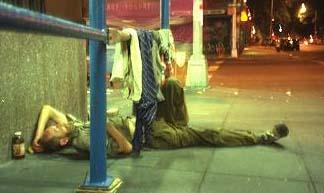
If selfish baseball fans ran the world and if Pedro Martinez were white, this would be Pedro Martinez.
Thankfully, though, this will never happen thanks to a wonderful thing known as
the Major League Baseball Player's Association, a union that ensures financial
security for players everywhere. You see, back in the 19th century, the working
man had no leverage. He was forced to take the wages he was given, and could not
ask for more. Then the union was invented in a laboratory by Sir Thomas Edison,
giving hope to working-class America and making sure that everyone was paid
fairly. The union then invaded the Confederacy, and the rest is history.
Even with the players' union, ballplayers have fought an uphill battle to put
food on their tables. Fans grew so extravagantly rich that they could afford to
pay four dollars for a Coke as they sat around watching the players sweat it out
on the diamond. When the players were forced to strike in 1994 to keep their
children fed and healthy, the fans grew furious and attendance levels plummeted.
Not until 1998, when Mark McGwire and Sammy Sosa went on a selfish,
non-team-oriented race for the home run crown, did revenue finally start coming
back in.
Unfortunately, the evil, decadent baseball fans threw another fit, and this past
summer, baseball appeared on the verge of another strike. I feared that baseball
may not recover from this strike as quickly as it did the last one. Before long,
dead bodies of starved baseball players would litter the streets, closing
schools everywhere as dead-body-mobiles clear the roadways until it is safe for
school buses to drive. Though players and owners were able to settle on a deal
just in time, the future still looks far from bright.
So as we make our final salute to the sinking, rudderless, "Speed 2: Cruise
Control"-esque ship we call baseball, let us remember some of the things that
made this game great…
Cal Ripken Breaks Consecutive-Game Streak
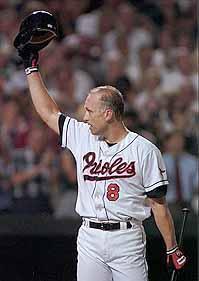
In 1995, Cal Ripken, Jr. broke one of the few remaining "unbreakable" records by
showing up like he was supposed to. Didn't necessarily drive in the game-winning
run…didn't make a game-saving catch…just showed up. For doing this, he received
a 10-minute standing ovation, made several curtain calls, and had the game
interrupted so they could hold a ceremony in his honor. All this happened in
front of the Baltimore Orioles faithful, who had paid to come to the ballpark
every game for the last eighty years. Meanwhile, Ripken got paid millions to do
it for seventeen years, and not necessarily well. Earlier in his career, he had
put together an MVP-quality season or two, but by the streak reached its end he
had become an antique of sorts, all the while keeping younger talent from
filling his position.
In most other professions, staying in the same position at forty that you were
at as a 25-year-old will normally earn you the title of "loser". Ripken does
this and is called such things as "American icon", "Future Hall-Of-Famer", and
"Cal Ripken, Jr." We salute you, Mr. Ripken, Jr.
The Success of the Obese
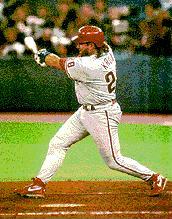
"Healthy enough to run a marathon? Probably not. Healthy enough to play
baseball? …The bases aren't that far apart."
-Former major leaguer John Kruk, on his physical state during the off-season
Obesity is a piece of Americana we should be proud of. It showcases our complete
mastery over the food chain, it makes us look more imposing, and most
importantly, it balances out the world's food surplus. Were it not for us, food
would be lying around everywhere, and schools would be closed even longer while
the dead-body-mobile drivers would be forced to work a double shift to clear the
streets.
Many of the most popular sports seem to harbor an unfair bias against the fat.
Since the soccer world is too shortsighted and narrow-minded to impose
obese-friendly rules (players must walk at all times, commercial breaks every 40
feet, etc.), fatties have been given the cold shoulder. But where all other
sports have failed, baseball has been there. Pioneered by the great Babe Ruth, a
slough of fatheaded butter-chompers have reached superstardom through years of
lumbering to the plate, knocking a pitch into the seats, ferrying around the
bases, and lumbering back to the bench.
The Lovable (and unlovable) Losers
The Chicago Cubs and Boston Red Sox haven't
won the World Series in nearly a century. Since then, they've watched younger,
newer teams take it all the way, climaxing in a World Series win for the
3-year-old Arizona Diamondbacks in 2001. Their stadiums are decomposing, their
records suck, and they face financial competition from other, less worthless
sports franchises in their respective towns. Yet fans fill the ballparks year
after year. Society holds a morbid fascination in observing misery, tragedy and
loss, which explains all the Holocaust museums we keep building.
On the other end of the spectrum is the plight of the Montreal Expos, named
after the 1976 World's Expositional Fair. Not to say that being a Cub or a Red
Sock is very noble or intimidating, but whose idea was it to name a team after
an event? What's next, the Birmingham Boycotts? The Los Angeles Raceriots? The
New York 9-11s, perhaps?
Few among us can pinpoint Montreal on a map (it's believed to be in Canada).
Fewer Montreal-ians (?) don't speak English. And still fewer give a flying fart
about baseball. Vladimir Guerrero, possibly the best all-around player in the
game, is not a household name solely because he's an Expo. And since he speaks
only Spanish, no one's been able to tell him that the Expos are the shittiest
team in baseball and that it is not customary to fill a 75,000-seat stadium with
4,370 people. I suppose it's better than Spanishland (?), but only marginally.
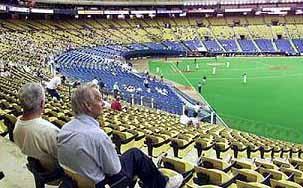
"Damn it, man. 66,724 empty seats, and you have to sit RIGHT next to me? I
mean, shit."
The 'Spos, as they're often called for some
reason, have been unable to sell television rights to anyone, and many of their
games can only be enjoyed (?) via radio, a situation unheard of in major North
American professional sports. Every other year, both fans have to endure rumors
of contraction (closing the team permanently). The Expos have been around since
1977, but have failed to make the playoffs once. To be fair, though, they posted
the best record in the majors and appeared World Series-bound in 1994 - the year
the strike canceled the playoffs and Series. Such is the life of an Expo.
Fights
A sport isn't any good without fights. They're the single saving grace of
hockey, they're comical to watch in basketball, and they're a way of life in the
soccer world, where rioting fans have caused soccer games to literally erupt
into wars.
You'll never see tennis players brawl, or soccer players throw down (their fans
do all the fighting). There's a reason for this: they're pussies. Tennis is too
civilized, and soccer players have the upper-body strength of a mashed potato.
Baseball players, on the other hand, lift weights relentlessly and chug Creatine
milkshakes until their balls shrivel away. The result: some pretty
strange-looking fights, actually.
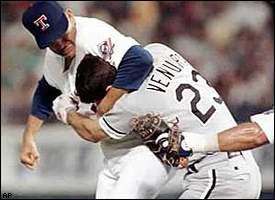
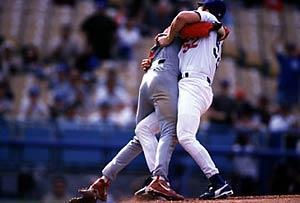
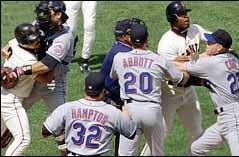
Baseball fights are quite different from barroom brawls or street fights, and
often look rather silly. There seem to be three basic maneuvers:
1 Headlock, then repeated punches to the gut
2 A strange manuever in which the players appear to hug vigorously and fall
down after a few seconds
3 Wild thrashing of limbs as the player tries to break free from those
attempting to restrain him
Most of these fights are started when the pitcher beans the batter. Usually the
batter will pace around for a few seconds, then make his way to first. At that
time, something snaps and he goes apeshit. Sometimes he'll throw a bat, other
times he'll just run headfirst toward the pitcher so he can get caught in a
headlock. Then the benches clear. It looks like a big fight is about to take
place, but in most cases, the majority of the players will charge the field like
mad, then just sort of stand around awkwardly. The few who do decide to mix it
up just find someone in the opposite uniform to shin-rake or thrash wildly at.
When they feel they have convinced the crowd and their teammates that they are
actually "fighting", they'll break up and stare uneasily at the two players that
started it all. By this time, the batter has probably still not found a way out
of the headlock, and the umpires/coaches manage to separate them.
So they may not be the manliest fights around (how much can be expected of a
bunch of guys with balls the size of BBs, anyway?). But they sure are funny.
* * *
Someday, baseball will finally be put out of its misery, save for a few
historical reenactments (just as soon as they've exhausted every possibility of
the Civil War). The Hall of Fame in Cooperstown will serve as a tribute to the
outdated and peculiar. Future generations will look upon baseball much like we
look upon that game the ancient Greeks played where they stripped naked and
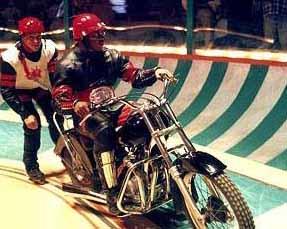
tried to skewer each other's genitalia with spears. Ah, well. At least we'll
have Rollerball.
- Jon
Jon@progressiveboink.com
AIM: Boiskov